
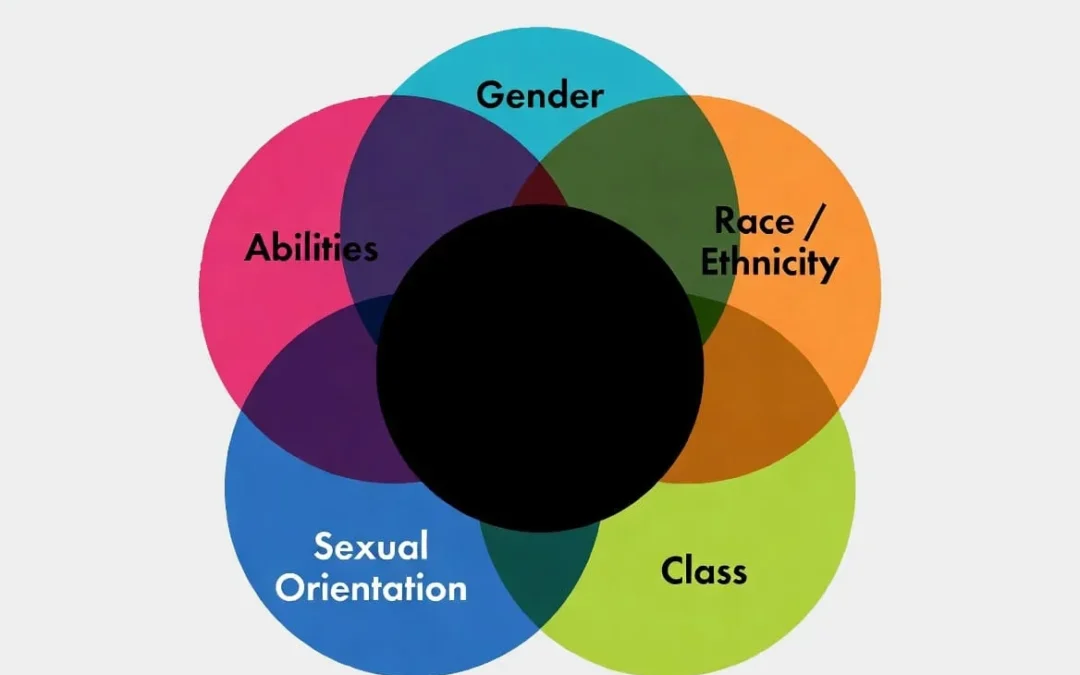
True Justice and real progress cannot be achieved by the false doctrine of “intersectionality” but only by the further application of America’s heritage of individualism and individual rights.
Intersectionality is a current claim about oppression in America. It asserts that non-whites, women, immigrants, homosexuals, and so forth are discriminated against—and that if an individual falls into several of these categories, then his (or her) victimization will be compounded. For example, a woman who is a black, Congolese, lesbian immigrant will face significantly more prejudice than would a native born black American heterosexual male.
In their book, Intersectionality, Patricia Hill Collins and Sirma Bilge offer a recondite definition of “intersectionality” but then go on to explain it: “This working definition describes intersectionality’s core insight: namely, that in a given society at a given time, power relations of race, class, and gender…are not discrete and mutually exclusive entities but rather build on each other and work together; and that, while often invisible, these intersecting power relations affect all aspects of the social world.”[1]
Scholar Kimberle Crenshaw, who coined the concept, described it like this: “Intersectionality is a lens through which you can see where power comes and collides, where it interlocks and intersects. It’s not simply that there’s a race problem here, a gender problem here, and a class or LBGTQ problem there. Many times that framework erases what happens to people who are subject to all of these things…. If someone is trying to think about how to explain to the courts why they should not dismiss a case made by black women, just because the employer did hire blacks who were men and women who were white, well, that’s what the tool was designed to do.”[2]
As a principle, intersectionality is one aspect of a constellation of racial beliefs that falls under the rubric of Critical Race Theory. In essence, the theory states that: 1. White people are racist 2. The United States is still dominated by white supremacy 3. The nation’s oppressed people—non-whites, women, gays, immigrants, and so forth—should stand together in solidarity against the white male oppressor.
Theorists of this school state these claims unequivocally. For example, Robin DiAngelo, an academic who instigated the field of “Critical Whiteness Studies,” wrote: “…a positive white identity is an impossible goal. White identity is inherently racist; white people do not exist outside the system of white supremacy.”[3] Similarly, Barbara Applebaum, a philosophy professor, stated: “…all whites, by virtue of systemic white privilege that is inseparable from white ways of being, are implicated in the production and reproduction of systemic racial injustice.”[4] A further example of many that might be provided was a 2002 Harvard Magazine essay with the jaw-dropping title “Abolish the White Race.” It said, in part: “The goal of abolishing the white race [conceived as a pernicious ‘social construct’] is on its face so desirable that some may find it hard to believe that it could incur any opposition other than from committed white supremacists.”[5] Finally, Applebaum makes clear that she endorses the viewpoint of critical race theorists Stephanie Wildman and Adrienne Davis who “contend that white supremacy is a system of oppression and privilege that all white people benefit from.”[6]
In essence, intersectionality and Critical Race Theory more broadly are anti-white racism combined with Marxism. White supremacists have long directed scorn at non-whites, and especially blacks who they accuse of both low intelligence and low morals. The intersectionalists may be thought of as the “new racists”, who openly and shamelessly spew forth relentless racist hatred of whites. Whites, they often claim, are uniquely (or at least primarily) responsible for slavery, imperialism, and genocide.[7] As seen, the intersectionalists also proclaim that whites are inherently racist, or, at the very least, benefit from a philosophy of white supremacism that is hard-wired into the American psyche and culture. After all, the Marxist element of such diverse “oppressed” groups as non-whites, women, gays, and immigrants uniting in opposition to the white male oppressor obviously relies upon the claim that white males are oppressive. The intersectionalist principle has diverse strands to it but the one it returns to over and again is that whites are intrinsically racist, especially toward blacks. This is its cardinal teaching.
But is it true?
Read the rest at Capitalism Magazine.
